Self-Contained Systems (SCS)
1. Introduction
Self-Contained Systems (SCS) is an architectural style promoted by INNOQ ↑SCS. It emphasizes decomposing complex systems into independently deployable units, each responsible for its own UI, business logic, and persistence. This allows teams to work autonomously, and systems to scale and evolve independently.
2. Key Characteristics
-
Each SCS is a vertical slice: it includes frontend, backend, and database.
-
There is no shared database or backend API between systems.
-
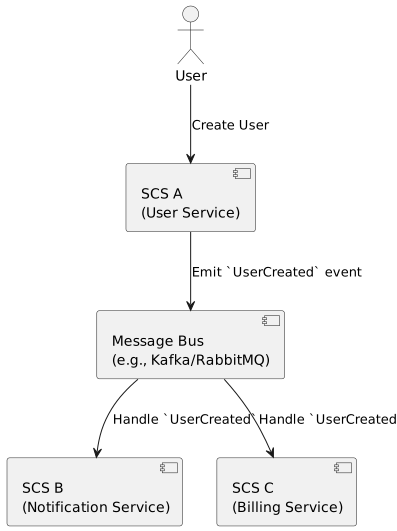
Communication between systems is asynchronous and event-driven.
-
Frontend integration is done via page or fragment composition, often using Web Components or Thymeleaf includes.
3. Frontend Integration
In SCS, each system serves its own UI. These UIs are composed together in the browser or at the server level using techniques like includes, iframes, or web components.
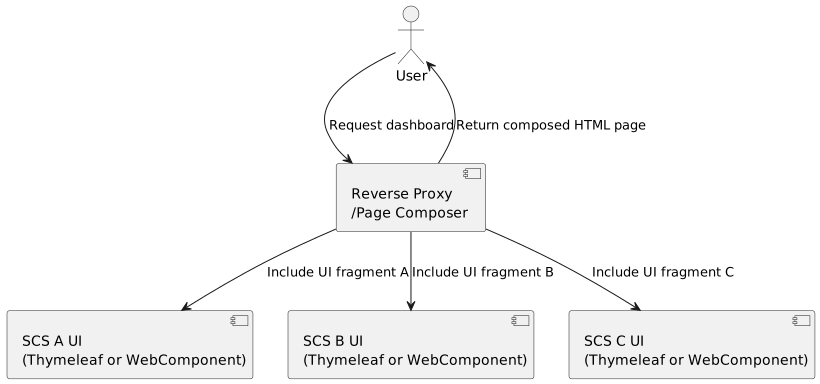
3.2. Example: Thymeleaf Template + Web Component
Each SCS may serve a Thymeleaf template and use custom Web Components to embed their functionality.
3.2.1. SCS-A Thymeleaf Template
<!DOCTYPE html>
<!--suppress ALL -->
<html xmlns:th="http://www.thymeleaf.org" lang="en">
<head>
  <title>SCS-A Page</title>
</head>
<body>
  <h2>Welcome to SCS-A</h2>
  <scs-a-widget></scs-a-widget>

  <script type="module" src="/static/scs-a-widget.js"></script>
</body>
</html>
3.2.2. SCS-A Web Component (scs-a-widget.js)
class ScsAWidget extends HTMLElement {
  connectedCallback() {
    this.innerHTML = `
      <div style="background: #eef; padding: 1em;">
        This is a self-contained component from SCS-A.
      </div>
    `;
  }
}
customElements.define('scs-a-widget', ScsAWidget);
3.2.3. Page Composition via Thymeleaf Include (in the Shell)
<html lang="en">
  <body>
    <div th:replace="~{scs-a :: content}"></div>
    <div th:replace="~{scs-b :: content}"></div>
    <div th:replace="~{scs-c :: content}"></div>
  </body>
</html>
This approach allows SCS-A, SCS-B, and SCS-C to render and manage their parts of the UI independently.
4. Asynchronous Data Transfer
SCS components should not make synchronous calls to one another. Instead, they exchange data through event messages, typically over a message broker.
This promotes loose coupling, autonomy, and resilience.
5. Benefits of This Architecture
-
Independent development and deployment
-
Teams work in parallel on full-stack features
-
System is resilient to failure of individual components
-
Scales better than tightly coupled monoliths
6. Downsides of Self-Contained Systems
While SCS offers many advantages in terms of modularity and autonomy, it also comes with certain trade-offs:
-
Increased Infrastructure Complexity: Every SCS must be independently deployable, which can increase operational overhead (CI/CD pipelines, monitoring, scaling, etc.).
-
UX Consistency Challenges: Since each SCS controls its own UI, maintaining a consistent look and feel across systems requires strong design governance.
-
Data Duplication and Synchronization: Systems often need to replicate data locally for performance and decoupling, leading to challenges in maintaining data consistency.
-
Cross-Cutting Concerns: Implementing features like authentication, logging, or analytics consistently across systems may require duplicated effort or shared libraries, which can reintroduce coupling.
These drawbacks mean that SCS is best suited for medium to large teams and projects where the benefits of team autonomy outweigh the coordination and infrastructure costs.
7. Summary
The Self-Contained Systems architecture enables high autonomy and scalability. They ensuring each system is independent in both UI and backend, and communicates only via asynchronous events. Frontend integration is handled through server-side includes or Web Components, maintaining both modularity and user experience.